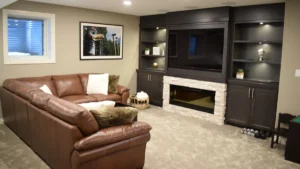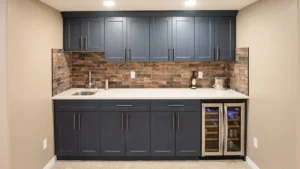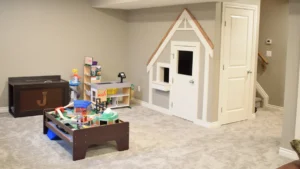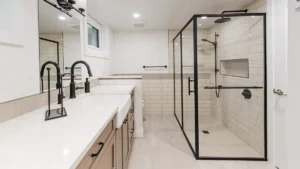
Most of our basements take 8 to 11 weeks to build once construction starts. Design, selections and permits come first. Those steps take anywhere from a few weeks to a couple of months. From your first call to a finished basement, plan for a few months.
Every basement development we build moves through the same steps in the same order. Below is how long each step usually runs and what tends to stretch it.
What Are the Steps in a Basement Development?
A basement moves through five steps, and the first four happen before construction starts.
- Plan and price. We walk the space, sort out the layout and give you a clear written price.
- Selections. You choose flooring, tile, fixtures and finishes.
- Drawings and permits. We prepare the drawings and pull the permits.
- Trade walkthrough and scheduling. Our trades see the space, and we book the start date.
Then the fifth step, the build usually takes 8 to 11 weeks. The first step covers the posts, plumbing and windows that decide where each room can go in a basement.
How Long Do Basement Permits Take in Edmonton?
A straightforward basement permit usually takes 1 to 2 weeks.
Complex layouts or wet bars can take 3 to 6 weeks or more. A wet bar is a bar with its own sink, a dry bar has no sink, so it skips the plumbing. We have seen wet bar permits take longer than dry bar permits.
Each municipality runs its own permit process. A basement in St. Albert or Sherwood Park goes through a different office than one in Edmonton.
Every basement development in Edmonton needs a permit before work starts. We prepare the drawings and submit the permit application for you. The City reports current timing on its building permit wait times page.
How Long Does It Take to Choose Finishes?
Most clients make most of their basement selections in our office in one visit.
We keep a showroom in our office for common basement selections. It can save clients 1 to 2 days of driving between stores.
For people in a hurry, we offer four ready-made design packages called quick-start mood boards. We expect fewer than 1 in 10 clients to choose them, mostly people who want to start fast. They shorten the process a lot for the people who do.
What Happens Between the Permit & the Start Date?
After the permit, we hold a trade walkthrough and set the start date, usually 3 or more weeks out.
At a trade walkthrough, each trade sees the space and confirms the details for their part of the job. You can follow the schedule on JobTread, the project management app we use, from your phone.
Homes built before 1990 get one more early step. A third-party company tests for asbestos before anyone disturbs anything. If the test is positive, an abatement company removes the asbestos safely. Then the tester checks the air. A clearance letter, the tester’s written note that the air is safe, comes back before other work carries on.
What Happens During the 8 to 11 Week Build?
The build follows a set order over 8 to 11 weeks.
Most of the important work happens before the basement looks finished. The rough-in stage comes early. That’s when our trades run pipes, wires and ducts inside the new walls. An inspector checks that work before we cover anything.
The first half of the build usually runs like this:
- Demolition and site protection, if anything needs to come out
- Framing, plus any structural or window work
- Plumbing, electrical and heating rough-ins
- Rough-in inspections
The second half finishes the space:
- Insulation and vapour barrier, then the inspection before the walls close
- Drywall, taping and paint
- Cabinets, flooring and tile
- Counters, fixtures and trim
Vapour barrier is a plastic sheet that keeps warm, moist air out of the walls. Final trade work, final inspections and your walkthrough close out the job. Size, finishes and complexity decide whether a basement lands near 8 weeks or near 11.
What Makes a Basement Development Take Longer?
Late decisions, changes after drywall and hidden problems in older homes slow a basement down the most.
Four things can slow a build down:
- A missed fixture choice. The valves behind a shower have to match the fixture you pick. Without that choice, the plumber can’t finish the rough-in.
- Changes after drywall. Moving a wall or an outlet means cutting the drywall open again.
- A wet bar. It adds plumbing and a longer permit.
- Surprises in older homes. On a 1960s home in Kenilworth, asbestos turned up in tape on old ductwork. It sat hidden above the ceiling, so nobody could test it beforehand. A third-party crew removed it before work went on.
NUVO prefers a clear timeline over a fast one that doesn’t hold up.
How Can You Keep Your Basement on Schedule?
Finish your selections before the build starts, and keep changes to a minimum once it begins.
Budget and schedule move together. What a basement development costs in Edmonton depends on the same rooms and finishes that set the timeline.
A much faster timeline from a contractor deserves a few questions. Has the contractor booked the trades? Have they ordered materials? Who is pulling the permits? Those questions sit at the heart of hiring a renovation company, along with licensing and insurance.
Basement Timeline Questions From Edmonton Homeowners
How long does it take to finish a basement in Edmonton? Most of our basements take 8 to 11 weeks to build. Add time before that for design, selections and permits.
How long does a basement permit take? A straightforward permit usually takes 1 to 2 weeks. Complex layouts or wet bars can take 3 to 6 weeks or more.
Can I speed up my basement development? Yes. Finish your selections early and avoid changes after drywall. Our quick-start design packages also save time.
Why does an older home take longer? Homes built before 1990 need asbestos testing first. Older basements can also hide problems that only show once walls and ceilings open.
When should I call if I want my basement done by a certain date? Call a few months ahead. That leaves time for design, selections, permits and scheduling.