The cost of a basement wet bar depends most on how far the sink sits from the drain. How big and custom the bar gets sets the rest.
What Sets the Cost of a Basement Wet Bar?
The distance from the sink to the drain sets most of the plumbing cost.
When the sink sits close to the drain, getting the drain there can cost under $1,000. Trenching about 20 feet can cost $2,000 to $3,000. To trench, the crew cuts a channel in the concrete floor for the new pipe. That price covers breaking out the concrete, the inspection, the backfill and the new concrete on top.
The bar itself adds to the price. A bigger bar with more cabinets or seating costs more than a simple one. Your wet bar also sits inside the full cost of a basement development, alongside the other rooms you build.
What’s the Difference Between a Wet Bar and a Dry Bar?
A wet bar has a sink with running water, and a dry bar doesn’t.
The first thing we ask is which one you want. That choice changes both the cost and the permit. A dry bar costs less, because it skips the plumbing. Wet bar permits usually take a little longer than the permit for a basement with a dry bar. The longer permit and added plumbing both influence how long a basement development takes.
Where Can a Wet Bar Go in Your Basement?
Usually only a couple of spots make sense, and the rest of the layout decides which ones.
The living room, the bedrooms, the bathroom and the existing rough-in all narrow it down. A rough-in is plumbing put in place before the walls close, ready for fixtures later. Bedroom windows matter too. Teleposts, the steel posts that hold up the main beam, decide where walls can go. Moving one takes engineering and a substantial investment.
How you like to host guests matters as well. Some people want a full bar with a sitting area. Others want a bar with a booth and a counter. In a Lake Summerside basement, we built a basement with a wine room around fixed limits. Every one of these choices is part of planning your basement layout around the plumbing.
What Is a Plumbing Wall, and Why Does It Help?
A plumbing wall is the wall where the plumbing already runs. Then a wet bar can often sit right on the other side.
Say the builder put the sink, tub and toilet rough-ins on the wall closest to the living room. We can often put the wet bar exactly on the other side of that wall.
Sometimes the plumbing from the upper floors runs down through a frost wall. A frost wall is the wood-framed wall built against the inside of the concrete foundation. If there’s already a stack nearby, the bar can tie into it. The stack is the main vertical drain pipe that carries waste out of the house.
What If There’s No Plumbing Near the Bar?
Then the plumber picks the nearest stack or drain, and we trench to the bar from there.
We chip the concrete to that drain, then add trenching all the way to the bar. The trench carries both the water lines and the drain.
New plumbing needs a permit and an inspection in Alberta. The drain also needs a vent to meet code. We pull the permit, and our plumber vents the drain. The Safety Codes Council’s permit requirements explain how permits and inspections work.
Does a Basement Wet Bar Need a Pump?
We usually recommend against lift stations and pumps, because they fail too often over time.
A lift pump pushes waste water up to a drain that sits higher. How long one lasts depends on how often it runs and on the pump itself. We’d rather bring the drain to the bar.
What Does a Simple Basement Wet Bar Include?
Most wet bars we build are 6 or 8 feet long, with a sink, drawers and a fridge spot.
A typical layout has a two-foot cabinet for the sink. Next to it sits a two-foot cabinet with drawers. The rest is an opening for a bar fridge. Most bars start at 6 feet and grow from there. Upper cabinets or floating shelves are options, and it customizes from there.
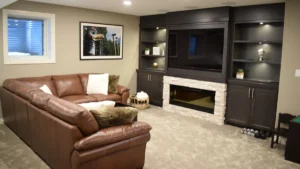
In a Windermere basement , the wet bar was built for entertaining. It sits beside a custom TV cabinet with surround sound. A wet bar can be a single room feature or part of a full basement development.
Basement Wet Bar Questions From Edmonton Homeowners
How far can a wet bar be from the drain? On NUVO jobs, sinks have sat anywhere from 3 feet to 20 feet from the drain.
How much does it cost to run a drain to a basement wet bar? Under $1,000 when the drain is close. Trenching about 20 feet costs $2,000 to $3,000.
Is a dry bar cheaper than a wet bar? Yes. A dry bar skips the plumbing, and its permit is simpler.
Does a wet bar need a permit? Yes. New plumbing needs a permit and an inspection. A wet bar permit usually takes a little longer.
Can a basement wet bar use a pump? It can, but we usually recommend against lift pumps because they fail too often over time.